US Map / County Maps / Louisiana
Louisiana Parish Map
Louisiana is the only state without counties. It has parishes, and the word came from the church.
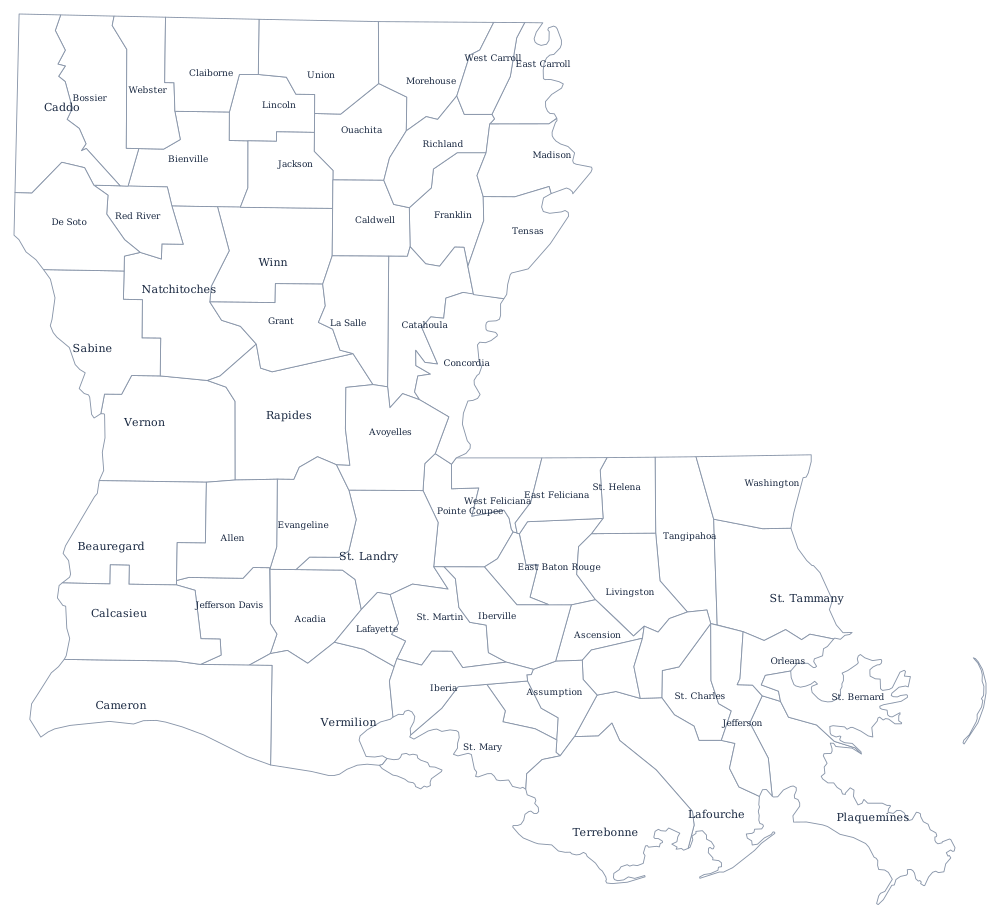
Under Spanish rule the colony was administered through ecclesiastical parishes, the local districts of the Catholic church, and when the territorial legislature organized civil government in 1807 it simply reused them: nineteen parishes, most of them named for their church. The 1845 state constitution made the term official. Everything else about Louisiana local government — the police jury, the civil law codes, the notarial land records — comes from the same French and Spanish inheritance.
The 64 parishes of Louisiana
The ten largest hold 58% of the state's people. East Baton Rouge and Orleans are both consolidated city-parish governments, and Jefferson Parish is the suburban ring west and south of New Orleans rather than a place with a center of its own.
| Parish | Parish seat | Population (2024 estimate) |
|---|---|---|
| East Baton Rouge Parish | Baton Rouge | 453,022 |
| Jefferson Parish | Gretna | 427,253 |
| Orleans Parish | New Orleans | 362,701 |
| St. Tammany Parish | Covington | 277,615 |
| Lafayette Parish | Lafayette | 254,241 |
| Caddo Parish | Shreveport | 224,893 |
| Calcasieu Parish | Lake Charles | 206,861 |
| Ouachita Parish | Monroe | 157,874 |
| Livingston Parish | Livingston | 152,886 |
| Tangipahoa Parish | Amite City | 139,823 |
Police juries, city-parishes, and the word parish
Most Louisiana parishes are still governed by a police jury, a name found nowhere else in the United States. It is a board of jurors elected by ward that sets the budget, maintains the roads and drainage, and appoints the parish administrator; the word jury here means a sworn body of citizens, not a court. Since a 1974 constitutional change parishes may adopt home rule charters instead, and about a third have, replacing the police jury with a parish council and a president.
Two parishes have merged with their cities. Baton Rouge and East Baton Rouge Parish consolidated in 1949, one of the earliest city-county mergers in the country, and New Orleans has been coextensive with Orleans Parish since the nineteenth century, with the city council serving as the parish governing body. Orleans is also the only parish with no police jury in its history. Elsewhere the parish sheriff is the most powerful local official in Louisiana: he is the tax collector as well as the police, an arrangement that survives from the colonial period.
Largest and smallest parishes
East Baton Rouge Parish is the most populous at 453,022 in the 2024 estimates, having passed New Orleans and Orleans Parish, now 362,701, after Hurricane Katrina. Jefferson Parish is second at 427,253. The smallest is Tensas Parish in the north-eastern Delta, 3,844 people on cotton land that has been losing population for a century. Cameron Parish, on the Gulf between Calcasieu Lake and the Texas line, is the largest by land area at roughly 1,310 square miles, and its 4,678 residents make it one of the emptiest coastal areas in the country.
The Louisiana state page covers the rest of the state, and the county map index covers the other 49. Across the lines: Texas, Arkansas, and Mississippi. The Mississippi River page follows the water that drew almost every parish line in the east.